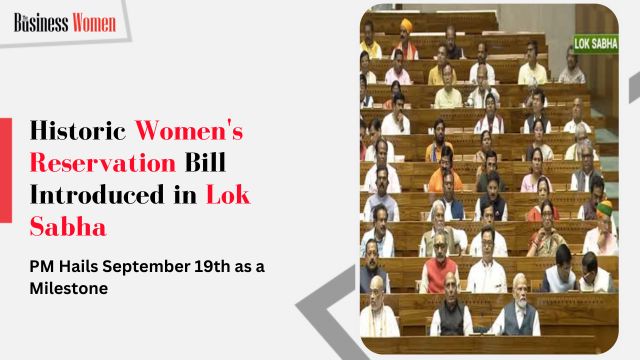
New Delhi: In a watershed moment in Indian politics, the Women’s Reservation Bill, aimed at securing a 33 per cent quota for women in the Lok Sabha and state legislative assemblies, was formally introduced in the Lok Sabha on September 19th. Prime Minister Narendra Modi enthusiastically hailed this occasion as a “historic day,” acknowledging the bill, officially titled the ‘Nari Shakti Vandan Adhiniyam,’ as a long-cherished aspiration that has lingered for nearly three decades. This legislative move carries the potential to significantly elevate the number of women Members of Parliament (MPs) in the Lok Sabha from the current count of 82 to an impressive 181.
Historical Context
Congress leader Adhir Ranjan Chowdhury attributed the genesis of the Women’s Reservation Bill to his party, underscoring the persistent efforts made by previous Congress-led governments, including those helmed by Rajiv Gandhi, PV Narasimha Rao, and Manmohan Singh, in attempting to secure passage for this landmark legislation. Nevertheless, he pointed out that despite successfully passing in the Rajya Sabha during the Congress administration under Manmohan Singh, the bill has languished without enactment.
Union Home Minister Amit Shah, however, challenged this assertion, asserting that the bill had already lapsed. The Women’s Reservation Bill’s history has been marked by numerous attempts and occasional setbacks throughout the years.
Key Provisions of the Women’s Reservation Bill
The Constitution (One Hundred and Twenty-Eighth Amendment) Bill, 2023, seeks to introduce several pivotal articles and clauses into the Indian Constitution:
- New Clause in 239AA: This clause mandates the reservation of seats for women in the Delhi Legislative Assembly. Furthermore, it calls for reserving one-third of the seats designated for Scheduled Castes (SCs) for women and one-third of the total seats filled through direct elections.
- New Article – 330A: This article addresses the reservation of seats for women in the Lok Sabha. It dictates that one-third of the seats allocated for SCs and Scheduled Tribes (STs) must also be reserved for women, in addition to one-third of the total seats filled through direct elections to the Lok Sabha.
- New Article – 332A: This article pertains to reserved seats for women in every state Legislative Assembly. In a manner similar to Article 330A, it prescribes that one-third of the seats set aside for SCs and STs must be reserved for women, alongside one-third of the total seats filled through direct elections to the Legislative Assembly.
- New Article – 334A: This article outlines that the reservation shall come into effect following the delimitation process, which occurs subsequent to the publication of relevant figures from the first census. It also establishes a rotation system for seats designated for women, to be reconfigured after each successive delimitation exercise.
A Long and Complex Journey
The odyssey of the Women’s Reservation Bill commenced in 1996 when it was first introduced in the Lok Sabha during the tenure of the United Front government led by Deve Gowda. Despite multiple re-introductions in subsequent years (1998, 1999, 2002, and 2003), the bill encountered insurmountable obstacles and failed to garner the requisite support for passage.
In 2008, during the UPA government led by Manmohan Singh, the bill found success in the Rajya Sabha, securing passage in 2010. However, it remained unaddressed in the Lok Sabha and ultimately lapsed with the dissolution of the 15th Lok Sabha in 2014.
The resurfacing of the Women’s Reservation Bill in the Lok Sabha now signifies a renewed effort to rectify gender disparities in Indian politics and usher in a transformative change in the representation of women within the country’s legislative bodies. The trajectory of this bill will be closely monitored as it navigates the intricacies of parliamentary debate and decision-making.