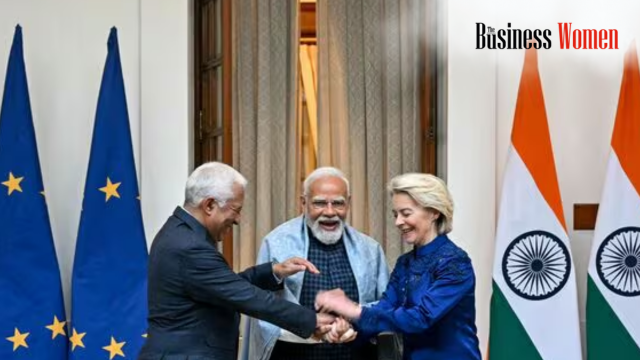
The India–European Union free trade agreement is not merely another trade pact—it is the culmination of nearly two decades of difficult diplomacy, shaped by shifting global power equations, domestic political sensitivities, and a rapidly evolving world economy. When European Commission President Ursula von der Leyen called it “the mother of all trade deals”, the phrase was not rhetorical flourish. It reflected the scale, complexity, and strategic weight of an agreement that brings together two of the world’s largest democratic economic blocs.
Prime Minister Narendra Modi, announcing the conclusion of the pact alongside European Council President Antonio Costa, described it as India’s biggest free trade agreement to date and a blueprint for shared prosperity. Together, India and the EU account for nearly 25% of global GDP, with a combined market approaching two billion people—a fact that alone makes this deal globally consequential.
Why This Deal Took 19 Years
Negotiations for an India–EU FTA began in 2007, stalled in 2016, and were revived only in 2022. The delays were not procedural—they were political and structural. India has historically protected its agricultural sector, where livelihoods, food security, and social stability are deeply intertwined. The EU, meanwhile, has consistently sought greater access to India’s agri-food market, one of the most protected among major economies.
What changed was the world. The COVID-19 pandemic exposed the fragility of global supply chains. The Russia–Ukraine war reshaped energy and food security concerns. Rising protectionism—especially renewed tariff pressures from the United States—forced both India and Europe to reconsider where reliable, long-term partnerships could be built. Against this backdrop, compromise became not only possible, but necessary.
The Core Shift: Opening India’s Market—Selectively
At the heart of the agreement is a fundamental recalibration of India’s import tariff structure, particularly for European agri-food products. Until now, Indian tariffs in this category have averaged 36%, with peaks of up to 150%, effectively limiting European exports despite India’s vast consumer base.
The numbers tell the story. In 2024, EU agri-food exports to India were valued at just €1.3 billion, accounting for a mere 0.6% of the EU’s total agri-food exports. This mismatch between market size and trade volume underscored both the opportunity and the frustration that defined negotiations.
The FTA seeks to unlock this potential—without triggering domestic disruption.
Wines, Spirits, and the Symbolism of Tariff Cuts
No provision has attracted more attention than the steep duty cuts on European alcoholic beverages, long considered politically sensitive in India:
- Wine tariffs will fall from as high as 150% to 20% for premium wines and 30% for mid-range wines
- Spirits duties will be reduced to 40%
- Beer tariffs will drop from 110% to 50%
These changes are economically significant, but they are also symbolic. They signal India’s willingness to open high-value, aspirational consumption segments, particularly in urban markets, while continuing to manage volumes and protect domestic producers.
Beyond Alcohol: A Quiet but Sweeping Reset
Less visible, but arguably more impactful, are the changes across a broad range of food and processed products:
- Zero import duty on olive oil, margarine, vegetable oils, fruit juices, non-alcoholic beer, and processed foods such as bread, biscuits, pasta, chocolate, and pet food
- Kiwis and pears see tariffs reduced from 33% to 10% within quotas
- Sheep meat tariffs fall to zero
- Sausages and meat preparations face duties cut by half, from levels as high as 110%
For Indian consumers, this expands choice and competition. For European exporters, it offers market access on terms the European Commission has described as better than India’s existing FTAs with the UK and Australia.
Liberalisation With Safeguards Built In
Crucially, the agreement does not represent a free-for-all. Both sides have embedded strong protective mechanisms.
The EU will retain tariffs on sensitive products such as beef, sugar, rice, chicken meat, milk powder, honey, bananas, wheat, garlic, and ethanol. It will also introduce calibrated import quotas for items including sheep and goat meat, grapes, cucumbers, dried onions, sweetcorn, and molasses-based rum.
A bilateral safeguard mechanism allows either side to intervene if imports surge in ways that threaten domestic markets—an assurance that liberalisation will remain controlled and politically sustainable.
Standards Are Not Up for Negotiation
One of the EU’s clearest red lines has been regulatory autonomy. The European Commission has stated unequivocally that “EU health is not negotiable.” All Indian agri-food products entering the EU must comply with its strict, science-based standards for food safety, animal welfare, and plant health.
The EU will retain full control over its regulatory framework, conduct impact assessments—particularly on pesticides and animal welfare—and increase audits and border checks where required. This insistence reflects a broader shift in global trade, where standards and trust matter as much as tariffs.
Protecting Heritage Through Geographical Indications
Running parallel to the FTA is a proposed Geographical Indications (GI) agreement, aimed at protecting traditional European food products from imitation in the Indian market. For the EU, this is about safeguarding cultural and economic value tied to origin and authenticity.
The creation of an EU–India working group on wines and spirits further institutionalises cooperation, offering a platform for technical dialogue, regulatory alignment, and smoother dispute resolution.
Trade as Geopolitics
This agreement is as much about strategy as it is about commerce. Europe is seeking to diversify partnerships and reduce over-dependence on a narrow set of markets. India, meanwhile, is leveraging its growth trajectory to secure deeper integration into global value chains on its own terms.
For India, the deal strengthens export prospects in textiles, gems and jewellery, leather, steel, and manufacturing, while reinforcing its standing as a reliable, long-term economic partner. For the EU, it provides privileged access to one of the world’s most promising consumer markets at a time when global trade alliances are being redrawn.
A Defining Moment
The India–EU free trade agreement marks a structural shift in how both sides view each other—not as transactional partners, but as long-term stakeholders in economic stability, strategic autonomy, and global governance.
As Prime Minister Modi noted, “This is not just a trade agreement—it is a blueprint for shared prosperity.” In substance and intent, the pact reflects a new realism: that in an uncertain world, deep, rules-based partnerships between like-minded economies matter more than ever.